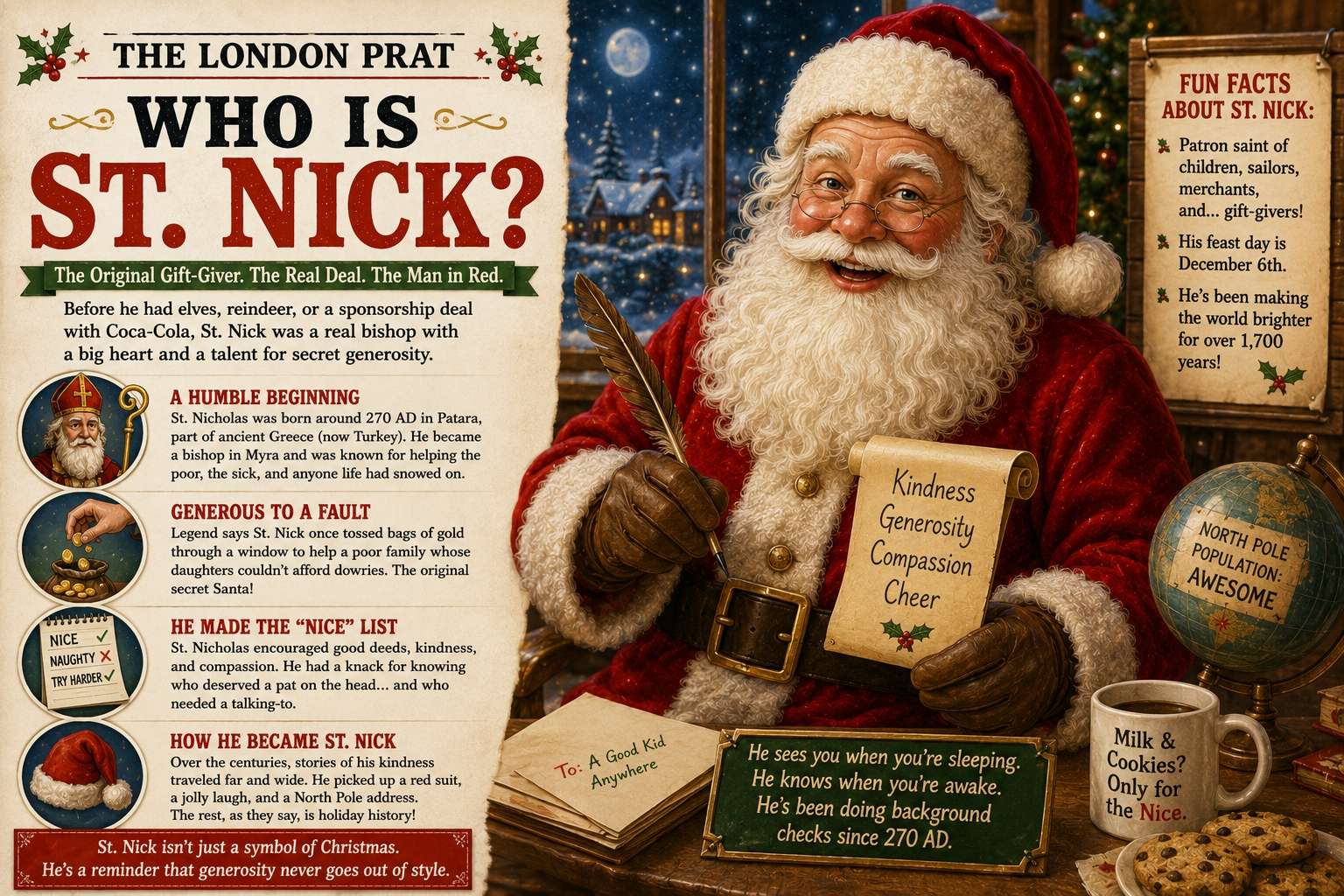
Who Is St. Nick?
The Friendly Short Form
“St. Nick” is simply the affectionate, shortened American nickname for Saint Nicholas, used almost interchangeably with Santa Claus in everyday speech, greeting cards, and holiday songs across the English-speaking world, particularly in the United States.
Popularized by a Famous Poem
The name owes much of its lasting popularity to Clement Clarke Moore’s 1823 poem “A Visit from St. Nicholas,” better known by its opening line, “‘Twas the Night Before Christmas.” The poem’s closing image — “Happy Christmas to all, and to all a good night” — cemented “St. Nick” as a warm, casual way to refer to the gift-bringer, distinct from the more formal “Saint Nicholas.”
The Authorship Mystery Behind “St. Nick”
The poem that made “St. Nick” a household phrase has a surprisingly contested history. “A Visit from St. Nicholas” was published anonymously in a Troy, New York newspaper in 1823, and it wasn’t until 1837 — fourteen years later — that Clement Clarke Moore, a wealthy Hebrew scholar, publicly claimed authorship, formally including it under his name in his 1844 poetry collection. But the family of Henry Livingston Jr., a New York poet, soldier, and land surveyor who died in 1828, insisted for generations that Livingston had actually written the poem years earlier and read it to his own children well before Moore ever claimed it. In the early 2000s, literary scholar Don Foster used computer-aided textual analysis comparing word patterns, rhythms, and vocabulary across both men’s known writings — and found the poem’s style matched Livingston’s work far more closely than Moore’s, reopening a debate that remains unresolved among Christmas historians today.
From Solemn Bishop to Jolly Elf
Before this poem, American depictions of St. Nicholas were notably different from the “St. Nick” we know: earlier illustrations, including one from 1821, showed a figure still wearing a variation of a bishop’s mitre and robes, driving a sleigh pulled by a single reindeer. It was specifically the disputed 1823 poem that transformed him into the “right jolly old elf” with twinkling eyes, rosy cheeks, and a belly that “shook when he laughed, like a bowl full of jelly” — and gave him, for the first time, eight named reindeer, a full seven years before Rudolph would eventually be invented as a ninth.
A Bridge Between Old and New
Writers like Washington Irving had already begun reshaping the historical, solemn bishop Saint Nicholas into a jollier, more folksy American figure in the early 1800s, and “St. Nick” captured that transition perfectly: familiar enough for a children’s story, yet still carrying an echo of the saint’s original religious roots.
St. Nick in American Holiday Language
“St. Nick” appears constantly throughout American Christmas vocabulary — from the phrase “Old Saint Nick” in holiday songs to countless product names, local charity drives, and even neighborhood Santa impersonator events, cementing it as one of the most commonly used informal names for the character in everyday speech.
Unlike “Kris Kringle,” which has taken on a secondary meaning as a gift-exchange game, “St. Nick” has remained purely a nickname for the man himself, retaining a slightly old-fashioned, storybook charm that many Americans associate with classic, pre-commercialized visions of Christmas.
Frequently Asked Questions About St. Nick
Where does the phrase “Old Saint Nick” come from? It comes largely from Clement Clarke Moore’s 1823 poem “A Visit from St. Nicholas,” which helped pop the nickname in American culture.
Is St. Nick used outside the United States? It’s occasionally used in other English-speaking countries, but it’s most strongly associated with American holiday tradition.