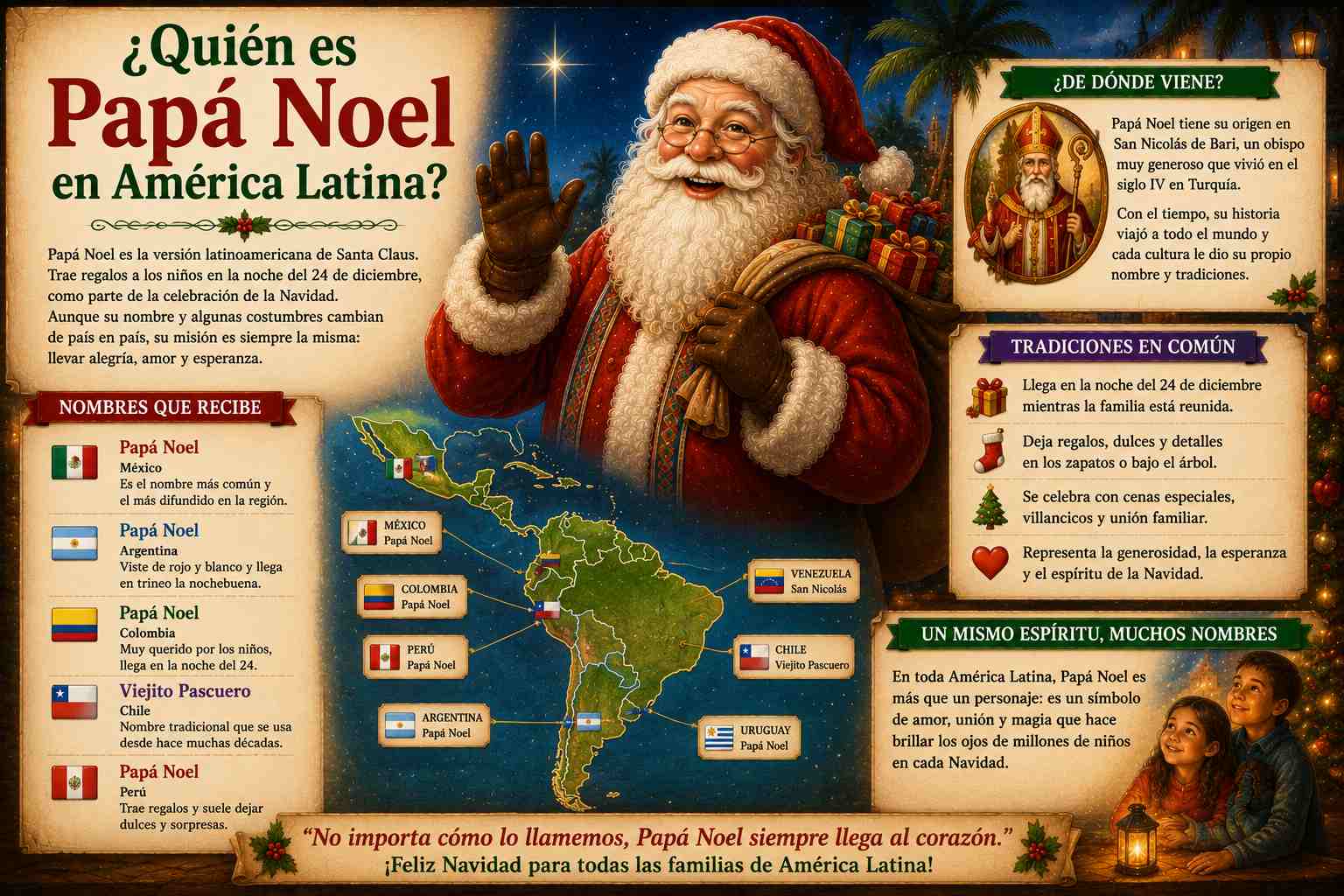
Who is Santa Claus in Latin America?
A Santa who arrives with warmth, not snow.
In much of Latin America, Santa Claus shares the spotlight with the Baby Jesus and the Three Wise Men, but his image as an older man with a beard, dressed in red, is widely recognized thanks to American and European commercial influence. Interestingly, in the Southern Hemisphere, Christmas falls in the middle of summer, so Santa Claus often appears in swimsuits or “lightened” versions of his classic fur-lined suit.
Christmas Eve as the central celebration
Christmas Eve dinner, on the night of December 24, is usually the most important moment of Latin American Christmas, with fireworks at midnight marking the official arrival of December 25 and, symbolically, the visit of Santa Claus while families are still awake celebrating.
Coexistence of traditions
Depending on the country—Argentina, Peru, Ecuador, among others—Santa Claus can coexist with local traditions of indigenous, Catholic, or mixed origin, which means that each Latin American country has its own particular way of receiving him.
A name that’s half translated
Few Spanish speakers stop to consider how curious the name “Papá Noel” itself is. The word comes directly from the French “Père Noël,” but when it crossed over into Spanish-speaking cultures in the 19th and early 20th centuries, translators only translated half: “Père” became “Papá,” while “Noël” simply remained “Noel,” without being translated into Spanish as “Navidad” (Christmas). The result is a hybrid name that, taken literally, doesn’t quite mean “Father Christmas” nor anything entirely Spanish, but rather a linguistic mix that reveals the French route by which this figure arrived in Latin America, instead of a directly Anglo-Saxon route as occurred in other parts of the world.
The case of the countries that prioritized the Three Wise Men
One little-known reason why Santa Claus took longer to become established in certain parts of Latin America, compared to the rapid spread of the Christ Child or the Three Wise Men, has to do with the colonial holiday calendar: in countries like Mexico, Colombia, and Venezuela, the most important holiday of the Christmas season was already January 6th, with the arrival of the Three Wise Men and the recognition of the Christ Child—a date that had been culturally associated for centuries with the giving of significant gifts along with the idea of reward or punishment. Santa Claus had to be inserted into an already established holiday calendar, rather than arriving in a cultural void, which explains why in some countries he still competes with, rather than having completely replaced, these older traditions.
A debate that also exists in Europe
Interestingly, the tension between Santa Claus and local religious traditions is not unique to Latin America. In Germany and Austria, organized movements have emerged actively promoting a return to Saint Nicholas or the Christkind in the face of Santa’s commercialization. German activist Bettina Schade has publicly argued that the Christian origins of Christmas “have taken a back seat” to the mere sale of gifts, while in Austria, activist Walter Kriwetz led a similar campaign to “save” the Christkind, explicitly stating: “We are not against Santa. He may be good for the British and Americans, but he is not good for us.”
Santa Claus and the warm weather of the southern hemisphere
One of the most talked-about aspects of Santa Claus in Latin America is the constant visual contradiction between his heavy winter suit and the region’s tropical or summer heat during December. Advertisements and local media often play on this contrast, showing “lighter” versions of Santa Claus in swimsuits or Hawaiian shirts as a humorous nod to this climatic reality.
In countries like Argentina, Peru, and Ecuador, Santa Claus shares the spotlight with extended family celebrations, where Christmas Eve dinner and midnight fireworks are often more central to family memory than the figure of the gift-giver himself.
Frequently Asked Questions about Santa Claus in Latin America
Is Santa Claus equally popular throughout the region? No, his popularity varies considerably from country to country and he competes with local traditions such as the Christ Child or the Three Wise Men.
Why are there fireworks at midnight on Christmas Eve? It’s a widespread tradition in much of Latin America to mark the official start of Christmas Day.