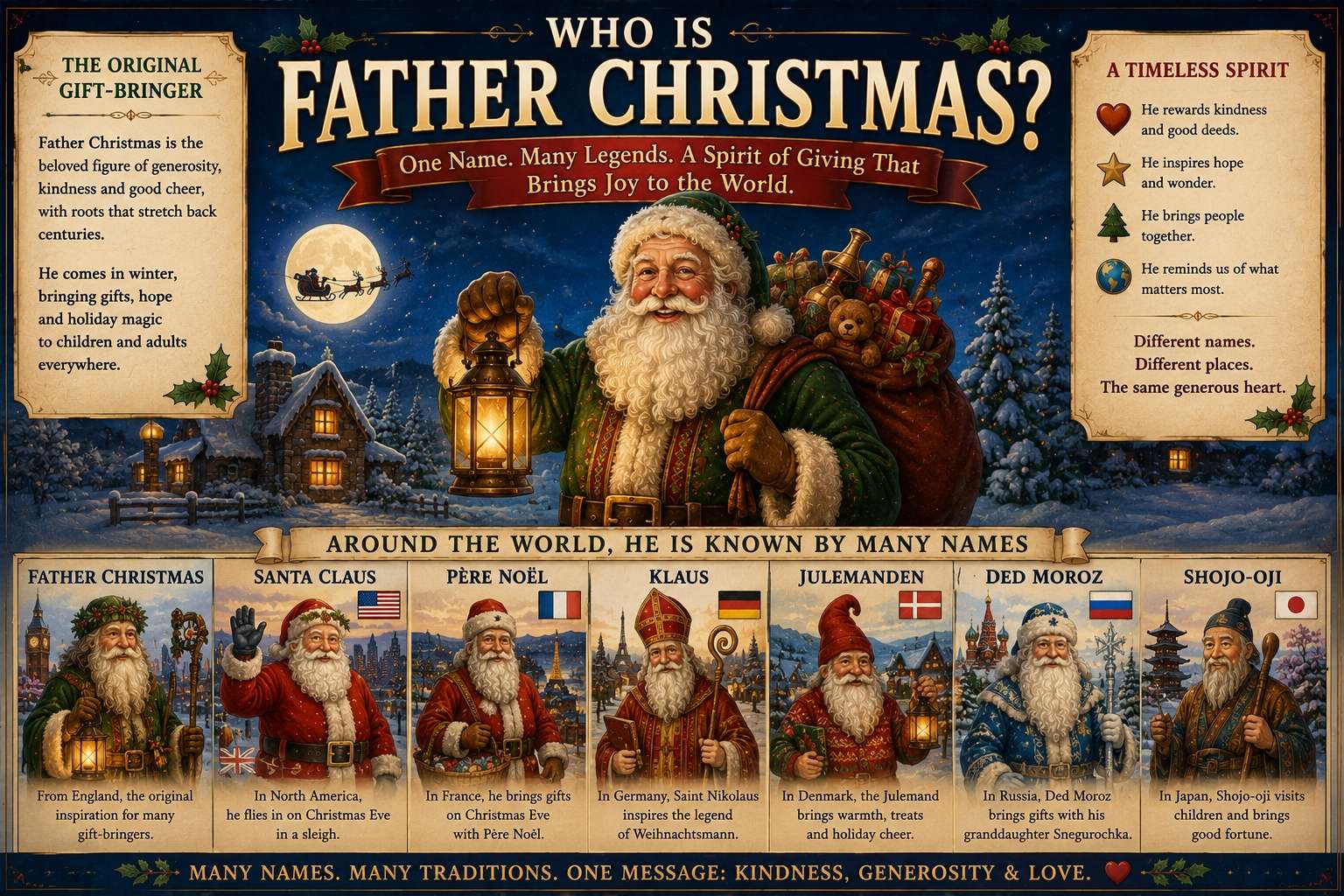
Who Is Father Christmas?
Older Than Santa Claus
Father Christmas is Britain’s own name for the gift-bringer of the winter holiday, and the figure actually predates the American “Santa Claus” by centuries. Medieval and Tudor England had a personification of the Christmas season itself — a jolly, robed figure representing feasting and goodwill, entirely separate from any saint or bishop.
Merging with Santa Claus
By the Victorian era, this older English character had merged almost completely with the Dutch-American Sinterklaas/Santa Claus tradition arriving from across the Atlantic. Charles Dickens’s “Ghost of Christmas Present” in A Christmas Carol helped cement the image of a large, generous, green-or-red-robed figure associated with abundance rather than judgement or punishment.
Banned by the Puritans: Christmas on trial
Few realise that Father Christmas was once a genuine political flashpoint. When Puritan-controlled Parliament outlawed Christmas celebrations in the 1640s during the English Civil War, considering the feast “popish” and its traditional revelry sinful, Royalist pamphleteers fought back by turning Old Father Christmas into a symbol of resistance — the embodiment of “the good old days” of feasting and hospitality under threat from Cromwell’s government. The 1658 pamphlet The Examination and Tryal of Old Father Christmas literally put the character on trial, portraying him as a persecuted defender of English tradition. When the monarchy was restored in 1660, Christmas celebrations returned, but Father Christmas himself faded into a largely forgotten folkloric memory for well over a century.
The 1879 letter that puzzled England’s folklorists
Father Christmas’s merger with the newly arrived American Santa Claus happened so quickly that it genuinely confused Victorian scholars. In January 1879, the antiquarian Edwin Lees wrote to the journal Notes and Queries describing a custom he’d heard about from “a country person”: children placing stockings outside their bedroom doors on Christmas Eve, expecting a “mythical being called Santiclaus” to fill them overnight. Lees, unaware this was an imported American practice, was genuinely baffled about “from what region of the earth or air this benevolent Santiclaus takes flight.” By the 1880s, the two figures had merged so completely that a French visitor to England in 1883 reported it was common knowledge that Father Christmas came down chimneys to fill stockings — a detail that, decades earlier, belonged to an entirely separate American tradition.
Father Christmas through the centuries: a timeline
| Period | Form | Key trait |
|---|---|---|
| 15th century | “Sir Christëmas” in carols | Announces the birth of Christ, encourages drinking |
| 1640s-1660s | Political symbol | Represents banned traditional feasting under Puritan rule |
| 18th century | Folk play character | Green or scarlet fur-lined robe, holly wreath, no gifts |
| 1843 | Dickens’s Ghost of Christmas Present | Green fur-trimmed robe, wassail bowl, generosity |
| 1880s-present | Merged with Santa Claus | Red suit, chimney entry, gift-giving |
Some folklorists trace Father Christmas back even further, to the Norse god Odin, whose Old Norse title Jólfaðr literally meant “Yule-father” — a bearded, cloaked figure who flew through midwinter skies on an eight-legged horse, a detail strikingly similar to the modern airborne gift-bringer.
Father Christmas Today
In modern Britain, “Father Christmas” and “Santa Claus” are used almost interchangeably, though “Father Christmas” retains a slightly more traditional, storybook feel. He is said to live at the North Pole, travel by reindeer-drawn sleigh, and enter homes via the chimney on Christmas Eve, leaving presents for children who have left out mince pies, a carrot for the reindeer, and — quite often — a small glass of sherry.
Father Christmas in Modern British Culture
Today, “Father Christmas” and “Santa Claus” are used almost interchangeably across the UK, though the older name still carries a distinctly British, storybook warmth that many families associate with traditional Christmas cards, pantomimes, and department store grottos — a peculiarly British institution where children queue to meet Father Christmas in elaborately decorated indoor “winter wonderlands” each December.
The BBC and British advertisers have played a significant role in reinforcing the modern image, particularly through iconic Christmas adverts that air every November and December, often featuring Father Christmas alongside themes of family, nostalgia, and generosity that resonate strongly with British audiences.
Frequently Asked Questions About Father Christmas
Is Father Christmas the same as Santa Claus? Functionally, yes — in modern Britain, the two names describe the same figure, though “Father Christmas” has older, distinctly English roots predating the American Santa Claus tradition.
Does Father Christmas visit on Christmas Eve or Christmas Day? Tradition holds that he visits overnight on Christmas Eve, leaving presents to be discovered on Christmas morning.
Was Father Christmas ever actually put on trial? Not literally, but the 1658 pamphlet “The Examination and Tryal of Old Father Christmas” satirically depicted him facing trial as a way of protesting the Puritan government’s ban on Christmas festivities.