by
by Catherine from Bristol, England
Dear Santa,
My name is Catherine and I am thirty-four years old, which I appreciate is not your typical correspondent. The last time I wrote to you I was seven, I asked for a Tamagotchi and a hamster, and I received the Tamagotchi but not the hamster, which I have now processed sufficiently to write to you without resentment. Mostly. I was a student at Redmaids’ High School and a member of the Redmaid’s Society.
Dear Catherine. I remember the letter. I also remember the hamster decision, which was made in consultation with your mother after a careful review of existing household responsibilities, your younger brother’s track record with the goldfish, and a structural assessment of your bedroom that suggested the hamster would have been living in a geography that was, frankly, not optimised for small mammals. The Tamagotchi was the correct call. I stand by it. I hope the resentment is genuinely mostly processed because you have always struck me as someone who deserves peace of mind, and thirty-four is a fine age to achieve it.

I am writing from Bristol, where I have lived my whole life except for three years in Edinburgh that I refer to as my wilderness period and which mostly involved a lot of rain, a great deal of oat-based food, and one very long winter that I am still recovering from climatologically. Bristol is better. Bristol has the suspension bridge and good coffee and a hill for every occasion, which is either charming or exhausting depending on whether you are walking up it or down it.
Bristol is one of my favourite cities on the entire route. The Clifton Suspension Bridge at night in December is one of the finest sights available from reindeer altitude in the British Isles, and I mean that without qualification. Blitzen once attempted to fly under it on a dare from Dasher in 1987 and we do not discuss what happened, but the bridge itself remains magnificent and entirely unharmed, which is more than can be said for Blitzen’s dignity.
Santa, the reason I am writing — the specific reason, after twenty-seven years of silence — is that I went back to visit my old school last month. Redmaids’ High School on Westbury Road, formerly the Red Maids’ School, founded in 1634 by a Bristol merchant named John Whitson for, and I am quoting the historical record here, “fortie poore women children.” I was not one of the original forty. I attended in the 1990s and early 2000s, which feels almost as distant.
I know Redmaids’ well. I have been delivering to that part of Bristol since considerably before your time there, and I want to say something about it that I have been meaning to put in a letter for several decades: the girls who come out of that school have a particular quality that I have noticed across generations of Christmas Eve visits. They are, as a cohort, quietly formidable. They do not make a great deal of noise about it. They simply get on with things, which in my experience is the more reliable variety of formidable.
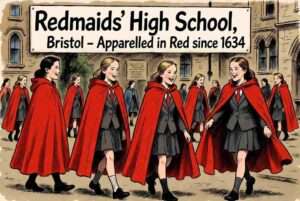
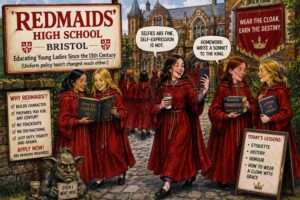
I wore the red uniform for seven years, Santa. Seven years. I want you to appreciate what that means. Not the dark red of a sensible winter coat or a tasteful Christmas jumper. The specific, committed, unapologetic red of an institution that has been dressing girls in red since the reign of Charles I and sees absolutely no reason to reconsider. We wore it on the bus. We wore it to the shops. We were, at all times, extremely visible. There was no possibility of anonymity in Bristol in that uniform. You were a Red Maid or you were not, and the city knew which.

The uniform has been a reliable navigational landmark from the air for longer than I care to admit. In the early decades of my Bristol deliveries, the red was actually useful — a cluster of girls in red on Westbury Road told me exactly where I was in relation to the Clifton delivery sequence and I could adjust the route accordingly. By the time you were attending in the 1990s I had the route memorised, but I still found the uniform oddly comforting. Like a landmark that also went home at four o’clock and had opinions about the lunch queue.
The thing about going back to the school as an adult is that it is considerably smaller than you remember. The corridors that felt endless when you were eleven are, it turns out, just corridors. The teachers who seemed ancient and unyielding were in many cases younger than I am now, which is a thought I have been sitting with uncomfortably for several weeks. The drama hall where I performed in three school productions, two of which I was too nervous to enjoy at the time, is just a hall. It is a very good hall. But it is just a hall.
This is one of the things I have observed consistently across several centuries of watching children grow up and return. The places shrink. The feelings do not. The drama hall that you were too nervous to enjoy at the time contains, somewhere in its walls, every version of you that stood on that stage, and none of those versions has gone anywhere. They are simply waiting to be remembered by someone old enough to appreciate them properly. You were braver than you knew, Catherine. You were braver than you felt. Most of the best people are.
I had a teacher called Mrs. Hargreaves who taught English and who had a particular way of returning essays that managed to be simultaneously encouraging and devastating, which I now recognise as a rare and valuable skill. She told me once that I wrote too carefully, that I was so worried about getting it wrong that I wasn’t saying anything interesting, and that the interesting thing was usually the thing I’d crossed out. I have thought about that note in the margin approximately once a week for twenty years.

Mrs. Hargreaves was right, and what she told you is one of the most useful pieces of advice a writer can receive and one of the hardest to act on. The crossed-out thing is almost always more honest than what replaced it. I would know. I have been writing letters — replies to children, notes to postal services in forty-seven countries, the occasional strongly worded memo to Prancer — for several centuries, and the sentences I nearly didn’t send are consistently the ones that mattered most. Write the crossed-out thing, Catherine. It is not too late. It was never too late.
I also had a friend called Becca who could make the entire year group laugh by doing nothing more than raising one eyebrow at precisely the right moment. We lost touch after sixth form. I don’t know why exactly. One of those things. I think about her sometimes, especially at Christmas.
I know about Becca. I know about a great many friendships that went quiet not because anything went wrong but because life moves at a pace that makes staying in contact feel like one more thing on a list that is already longer than the day. I am not able to reconnect people — that is considerably outside my operational remit and also somewhat beyond my technical capabilities, though the elves have suggested apps that they claim can help. What I can tell you is that a friendship strong enough to make an entire school year laugh with one eyebrow is not the kind of thing that disappears. It simply waits. The finding is usually easier than it looks. Most things are.
What was the school like before I was there, Santa? You said you’ve been delivering to that part of Bristol for a long time. What did you see?
I will tell you what I noticed, across the years.
In the early decades, the girls were younger than you would expect and the building was colder and the red was a deeper, rougher cloth than the one you wore. The circumstances that brought children to the school were harder than anything you would recognise. John Whitson — your founder, the merchant, the mayor — created something that mattered in a city where mattering was not guaranteed for the girls he had in mind. I am not an uncomplicated admirer of every Bristol merchant of that era, and I think you are old enough to hold that complexity without needing me to smooth it over. But the school itself, what it did for the children in it, century after century — that I watched, and that I respected.

Later, in the Victorian years, the uniform was more elaborate and the curriculum was more restricted and the girls were being prepared for a world with a specific and limited set of destinations. But even then, in the classrooms on winter evenings when the lamps were lit and the city outside was cold, there was something being passed between the women teaching and the girls learning that was not in any curriculum. A quality of attention. An expectation of seriousness. A refusal to accept that being female was a reason to know less.
By the time you arrived in the 1990s, the school had changed enormously and not at all. The uniform was still red. The hill was still steep. The girls were still, in the aggregate, quietly formidable. And I still adjusted my Bristol route to come along Westbury Road at a particular point in the evening, not because the navigation required it, but because I liked what I saw there. I still do.
I’m not sure what I’m asking for, Santa. I don’t really have a wish list. I think I just wanted to tell someone about going back. About the corridors being smaller. About Mrs. Hargreaves. About Becca and the eyebrow. About the uniform that made us visible whether we wanted to be or not, and how strange it is to miss something you spent seven years being embarrassed by.
You are not asking for anything. You are doing something more useful, which is remembering carefully and out loud. That is how the things worth keeping stay kept. The corridors are smaller because you are larger — not physically, though presumably somewhat, but in every way that matters. The uniform embarrassed you because you were young enough to want to disappear and it wouldn’t let you. That is, in retrospect, one of the better things it did for you. You cannot spend seven years being visible in Bristol in that particular red and come out the other side without having learned, somewhere in your bones, that you are allowed to take up space. I think you know that now. I think Mrs. Hargreaves knew you would.
Merry Christmas, Catherine. Write the crossed-out thing. Find Becca. Walk the hill — whichever direction feels right. And thank you for writing after twenty-seven years. The silence was fine. The letter is better.
Thank you, Santa.
Yours,
Catherine Elspeth Rowland
Bristol, England
P.S. I still think I should have got the hamster.
You were never going to get the hamster, Catherine. But the fact that you are still making the argument at thirty-four suggests a quality of persistence that has almost certainly served you better. Almost.
IMAGE GALLERY
Redmaids’ High School — Bristol, England