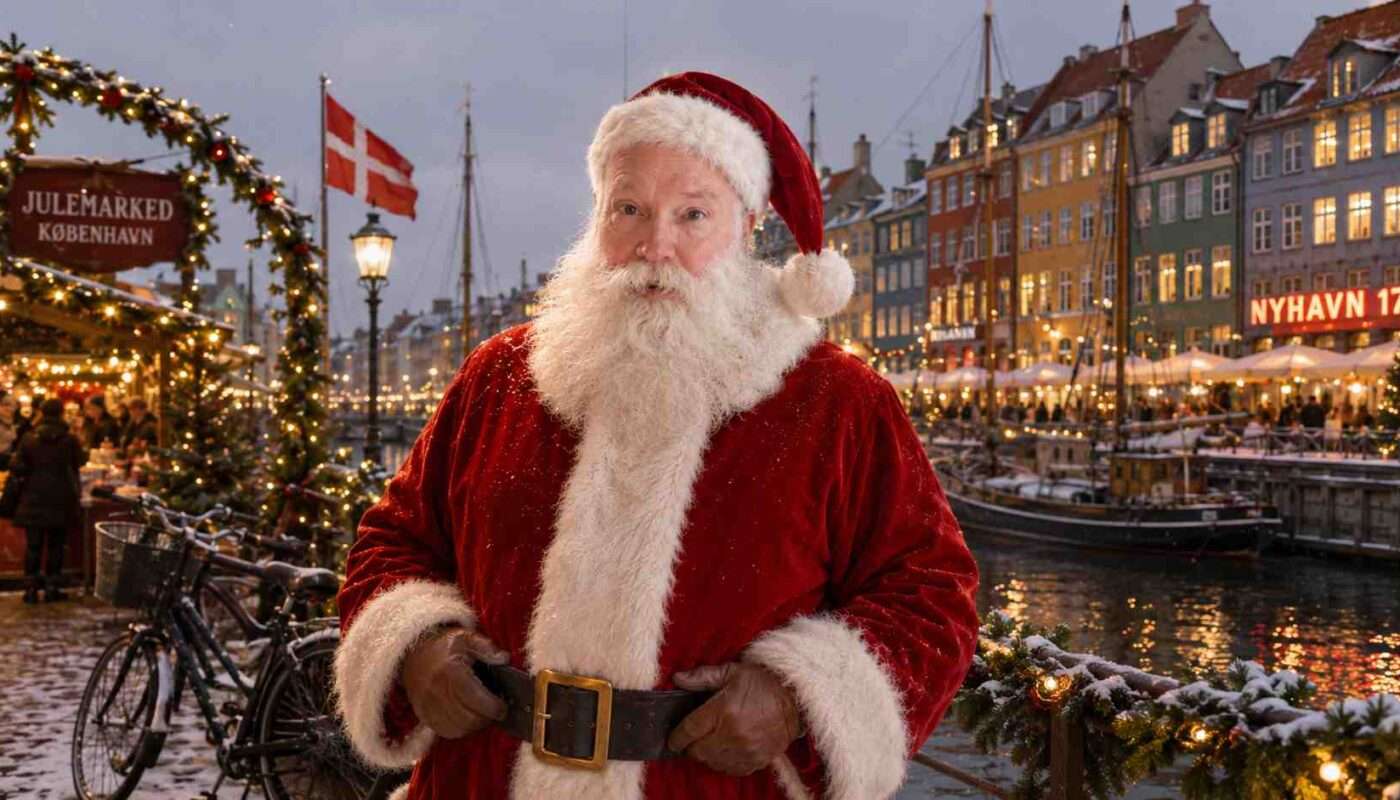
 by
by Astrid from Copenhagen, Denmark
Dear Santa,
My name is Astrid and I am twelve years old. I live in Copenhagen, Denmark, which my teacher says is one of the happiest countries in the world, which I find interesting because I do not always feel like one of the happiest people in the world, which makes me wonder if happiness is an average and what happens to the people on the wrong side of it.
I have three questions.
How do I find balance in a crazy world?
Why is Denmark a peninsula and a group of islands and how does that affect who we are?
Why do some governments take care of their people and others do not?
Thank you.
Astrid Lindqvist-Møller
Copenhagen, Denmark
Dear Astrid,
Your observation about happiness being an average and what happens to the people on the wrong side of it is one of the most precise things anyone has sent to this address in quite some time, and I want to be clear about that before I say anything else. You are twelve years old and you have identified one of the central problems with how societies measure wellbeing. Researchers who study this for a living have written entire books about it and arrived at the same discomfort you reached this morning before writing a letter. The question is a good one and the feeling behind it is real and you are not failing Denmark by having it. Denmark is fine. You are allowed to be complex inside a happy country. Most of the most interesting people are.
How to find balance in a crazy world.
Astrid, I have been flying over this world for several centuries and I want to tell you something about it that took me a long time to understand: the world has always been crazy. This is not a new condition. The people who lived through the Black Death, the people who lived through two world wars in the same century, the people who lived through every famine and revolution and collapse that fills the history books your class has not yet reached — all of them experienced their moment as uniquely, unbearably chaotic. All of them were right. Chaos is not a modern invention. What changes is which chaos you are living inside of.
This is not meant to minimize what you are carrying. The specific chaos of right now — the noise of it, the speed of it, the way information arrives faster than anyone can process it and the world’s problems are visible in real time from a small rectangle in your pocket — that specific texture of overwhelm is genuinely new and genuinely hard. I am not dismissing it. I am telling you that human beings have always had to find balance inside conditions that did not naturally provide it, which means that balance is not something the world gives you when it finally calms down. The world does not calm down. Balance is something you build inside the noise, on purpose, repeatedly, with the understanding that you will lose it regularly and that losing it is not failure — it is simply Tuesday.
Here is what I have observed, across several centuries of watching people find their footing in difficult times.
Balance is not stillness. People imagine balance as a state of having everything sorted, nothing pulling too hard in any direction, the scales perfectly level. That is not balance. That is stagnation. Real balance is dynamic — it is the constant small adjustments a cyclist makes to stay upright, none of which are visible from the outside but all of which are happening constantly. You are not trying to stop moving. You are trying to keep moving without falling. The adjustments are the work. They never stop being the work.
The first practical thing is smaller than it sounds: decide what is yours to carry and what is not. The world’s problems are real and your concern for them is honourable. But concern without boundary becomes weight without purpose. You cannot carry the whole world, Astrid. Nobody can. What you can carry is your corner of it — the people immediately around you, the choices immediately in front of you, the small area of the world where your actions actually make contact with reality. Carry that well. Let the rest inform you without crushing you. This is not selfishness. It is sustainability.
The second thing: your body is part of the equation and it votes loudly. Sleep, movement, time outside, food that is actual food — these are not luxuries or rewards for when everything is calm. They are the infrastructure of balance. The North Pole runs on this principle. The elves who skip sleep in November to get ahead are consistently less effective by December than the elves who maintained their routines. Mrs. Claus has said this at every pre-Christmas briefing for forty years. The elves keep being surprised by it. Do not be surprised by it.
The third thing is the one people find hardest to believe: balance includes joy, deliberately chosen, without guilt. Not joy that arrives after everything is fixed — that joy never comes, because things are never all fixed simultaneously. Joy on a regular Tuesday afternoon in Copenhagen in November when it is dark by three and the world is heavy. Joy taken on purpose because the alternative is giving the weight of the world permission to be the only thing you feel. Read the book that does nothing except delight you. Walk by the canal for no reason. Sit with the people who make the noise quieter. Do this without waiting to deserve it. You already deserve it. You are twelve and you are paying attention and the world needs people who pay attention to also still be standing when the thing that needs doing arrives.
Why is Denmark a peninsula and islands and how does that affect who we are?
Denmark is the Jutland Peninsula — attached to the European continent at the south through a narrow connection with Germany — plus approximately four hundred and forty-three islands, of which around one hundred are inhabited. The largest are Zealand, where Copenhagen sits, Funen, and Bornholm, which sits alone in the Baltic Sea considerably closer to Sweden and Poland than to the rest of Denmark and has always had its own particular identity as a result.
What does this geography do to a people? More than most Danes acknowledge consciously. Island and peninsula cultures develop specific qualities: a strong sense of defined boundary, because the sea makes borders physical and undeniable in a way that a line on a map does not. A tradition of seafaring and trade, because you cannot be surrounded by water without eventually deciding to use it. A degree of self-reliance, because being separated from the mainland — even by a narrow strait — creates the habit of solving problems with what you have. And a particular relationship with neighbours: you know exactly who is across the water, you have always known, and the history of that knowing includes both conflict and cooperation in proportions that shaped everything from your language to your architecture to the particular Danish quality of social trust that researchers keep measuring and finding remarkable.
Copenhagen is on an island. You live on an island. The water around you is not just scenery. It is the reason the city is here, the reason Denmark developed the trade networks that built its prosperity, and the reason Danes have a word — hygge — for the specific warmth of being enclosed with people you trust against the cold outside. You cannot have hygge without the cold outside. You cannot have the warmth without the boundary. This is, incidentally, also true of balance.
Why do some countries take care of their people and others do not?
This is your social studies question and it deserves the honest answer rather than the simple one.
Countries that take care of their people — with functioning healthcare, education, social safety nets, reliable infrastructure — tend to share several characteristics that are not accidental. They tend to have high levels of social trust: people believe that others will follow the rules, that institutions are fair, that their taxes will be used for what they were collected for. That trust makes people willing to contribute to a common system because they believe the system works. High trust societies build better institutions. Better institutions generate more trust. The cycle is real and Denmark is one of the clearest examples of it operating at national scale.
Countries that do not take care of their people tend to have had that cycle broken — by colonial extraction that removed wealth and destroyed institutions before they could develop, by internal conflict that made trust impossible to maintain, by governance captured by narrow interests that redirected common resources toward private accumulation, or by the simple and brutal geography of poverty that makes building institutions expensive precisely when the resources to build them are least available. These are not moral failures of the people living in them. They are structural conditions, often imposed from outside, often sustained by forces that benefit from the dysfunction continuing.
Denmark did not become Denmark by accident. It built its social model over more than a century of deliberate political choices, strong labour movements that negotiated the terms of the economy, and a cultural consensus that collective provision was in everyone’s interest including the wealthy. It also had advantages: a relatively small and initially homogeneous population, no major colonial wars on its own territory, geographic isolation that limited some of the disruptions that affected larger neighbours. None of this makes Denmark’s achievement less real. But it makes the achievement more complicated than “some countries simply chose to care,” which is the version that lets everyone else off the hook.
The honest answer is that caring for people at a national scale requires institutions, trust, resources, and political will — and that the absence of any one of them makes the others harder to sustain. Building those conditions where they do not exist is the hardest work in public life. There are people doing it in every country. They deserve to be known about. They deserve support. They are often not the loudest voices in the room. This is something worth paying attention to as you grow into someone who votes and works and eventually decides what kind of country you want to live in and what you are willing to do to keep it.
Merry Christmas, Astrid. Balance your world in the only way anyone ever has: one small adjustment at a time, on purpose, repeatedly, without waiting for the world to settle down first. It does not settle down. You settle into it. There is a difference and the difference is everything.
Your friend,
Santa Claus
The North Pole
P.S. You are not on the wrong side of the happiness average. You are on the thinking side of it. These are not the same place and the thinking side, while less comfortable, produces better questions. You have demonstrated this already. Keep going.
SOURCE: balancemyworld.co.uk