 by
by London, England — London Kalibari
Dear Santa,
My name is Priya and I am eleven years old. I live in London with my parents and my nani, which is what I call my grandmother, who has been in this country for thirty-one years and still refers to the weather as “temporary,” which we all find optimistic but nobody wants to correct because she is seventy-one and has earned her opinions.
Dear Priya. Your nani is correct to call the weather temporary. All weather is temporary. In London it is simply temporary at a frequency that exhausts most people into acceptance. Thirty-one years of refusing to accept it is not optimism. It is a form of courage that I have enormous respect for, and I mean that without a single trace of irony.

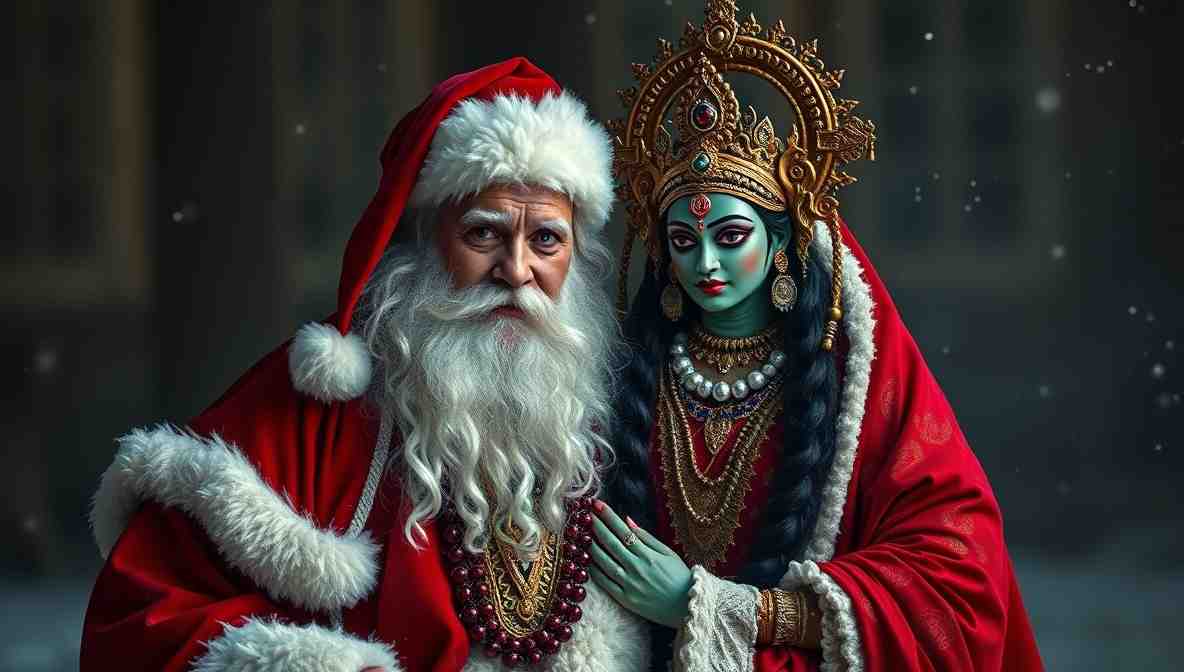
Santa, I want to tell you about a place called London Kalibari. It is a charity near where we live, and my nani goes there every week. Kalibari means “house of Kali” in Bengali — Kali is a Hindu goddess, very powerful, a little frightening if you only look at the pictures without understanding the context, which is something I have had to explain to several people at school who found her on the internet without the context. With the context she makes complete sense. Without it she is a lot.
Goddess Kali is indeed a great deal without context, and context is one of the things I have been collecting for several centuries. What I know about Kali is this: she is the goddess of time, change, and the destruction of evil — which means she is, at her core, about transformation and protection, and about the kind of fierce love that does not flinch from difficulty. I find that I have considerable professional sympathy for a divine figure associated with showing up for people in the dark. We operate in the same general territory, though I will admit my iconography is considerably less dramatic and the reindeer are less alarmed by me than they would be by Kali, which is probably for the best.
London Kalibari does things like a Senior Citizens’ Luncheon Club, and a Women’s Group, and yoga classes, and music and dance classes, and they do the worship of Goddess Kali and other Hindu deities, and every year they do Diwali and Kalipuja on a big scale. My nani goes to the Luncheon Club every week. She sits with other Bengali ladies and they eat together and talk and sometimes argue about things that happened forty years ago with the same energy as if they happened this morning, which my mum says is a sign of good memory and my dad says is a sign of something else entirely but he says it quietly.
The Senior Citizens’ Luncheon Club at London Kalibari is, from where I sit — which is rather high up and covers a great deal of ground — one of the most important things happening in that part of London on any given week. I want to explain why, because it is easy to look at a small charity with seven trustees and fifteen volunteers and a total income of under twelve thousand pounds a year and think: that is a small thing. It is not a small thing. It is one of the largest things. Your nani sitting with other Bengali ladies eating and talking and arguing about events from forty years ago with full present-tense energy — that is not a lunch. That is a community maintaining itself. That is people who came a very long way from home building a home that fits them, in a city that does not always make that easy, on a budget that would not cover a single meeting room in most London office buildings. That is extraordinary. The elves who reviewed the charity accounts were, I will tell you, quietly moved.
Santa, I have some questions.

First, do you deliver to everyone? Because my friend Aanya says you only go to Christian houses and I told her I didn’t think that was right and she said her older brother told her and I said her older brother also told her that the Piccadilly line goes to Brighton which it does not, so his information is not always reliable.
Your instinct is correct and your Aanya’s older brother’s geographical record is not encouraging. I deliver to every child. This has always been the case. I do not check religion at the door. I do not check immigration status, language, or the particular name a family uses for the divine, of which there are a great many and all of which I have encountered in several centuries of correspondence. Christmas is Christian in its origins and I will not pretend otherwise, because I was there at the beginning and the story matters to me and honesty matters more. But what the story actually asks of people — generosity, kindness, attention to those who are struggling, showing up in the dark with something good — those are not instructions exclusive to one tradition. Every tradition I have ever encountered has a version of the same ask. I try to honour all of them. The sleigh is large. There is room.
Second, do you know about Diwali? Because we celebrate both Diwali and Christmas in our house, which some people at school find confusing and which I find completely logical because one is the festival of light in October and one is the festival of giving in December and both of them involve good food and my nani making something that takes three days to prepare, so in our house the traditions are very compatible.
I know Diwali well. I have been flying over India, and over Indian communities in London and Leicester and Birmingham and everywhere the diaspora has built its home, on Diwali night for longer than most of those cities have existed in their current form. Diwali from the air is one of the most beautiful things I see in any year. The lights below look like the stars decided to come down and have a closer look at what people were doing, which is a feeling I understand completely. Your house celebrating both Diwali and Christmas is not confusing. It is a house that has decided to collect light wherever it finds it. That is an excellent policy. The North Pole operates on exactly the same principle.
Third, my nani came to England in 1994 with very little and she has never once complained about that, not even slightly, not even when my dad accidentally put her good sari in a thirty-degree wash and it came out a size that would only fit someone considerably more petite than my nani. She just looked at it for a long time and then said something in Bengali that my mum said I was too young to understand. My question is: does my nani make the nice list? Because I think she should be at the top of it.

Priya. Your nani has been on the nice list every year since she arrived, and several years before that, and I want to tell you something about the nice list that I do not say to everyone because not everyone asks the right question to deserve it. The people who are most securely on the nice list are almost never the ones who are thinking about the nice list. They are the ones who are thinking about the lunch they are going to share, the community they are going to build, the sari that can be quietly mourned and set aside without making the person who ruined it feel worse than they already do. Your nani arriving in this country in 1994 with very little and building a life of warmth and weekly lunches and strong opinions about forty-year-old arguments is the kind of story the nice list exists to honour. She is not at the top of it. She is in a category that does not have a rank because ranking it would be beside the point.
Fourth, what do you think about the volunteers at London Kalibari? Because they give their time for free and the trustees do not get paid and the whole thing runs on eleven thousand pounds a year, which my dad says is less than some people’s monthly rent in London, which I believe because the rents in London are something my parents discuss with the energy of the Bengali ladies and the forty-year-old arguments.
The volunteers at London Kalibari are doing something that I consider one of the most fundamentally important things a person can do, which is giving time — the one thing nobody can make more of — to people who need company, community, and a place that feels like home. Eleven thousand pounds a year and fifteen volunteers running a luncheon club, a women’s group, yoga classes, music and dance classes, and an annual Diwali celebration for a Bengali community in London is not a small operation run on a small budget. It is a large operation run by large-hearted people who have decided that the absence of resources is not the same as the absence of responsibility. The North Pole has seven thousand elves and a year-round production schedule and I still think the London Kalibari volunteers are working harder, proportionally speaking. Please tell them the North Pole said so. Mrs. Claus said I should say that specifically and she is, as always, right.

My wish list this year is: a new book about Indian history that is written for people my age and does not leave out the complicated parts, because the uncomplicated version is less interesting and also less true. Also, I would like the yoga classes at Kalibari to keep going because my nani has been sleeping better since she started going and she says it is the yoga and my mum says it is the company and they are both probably right. And I would like, if it is possible, for London to feel a little more like home for the people for whom it is still quite hard.
The book is noted and is an excellent request — a child who wants the complicated version of history is a child who has understood that the uncomplicated version is not a kindness but a reduction, and that the people whose stories get left out of the simple version are usually the people who most deserve to be read about. I will find you a good one. The yoga classes continuing is a wish I support with full North Pole endorsement and will send in the direction it needs to go. And the last wish — London feeling more like home for the people for whom it is still quite hard — that is the largest thing on your list and the one I can do least about directly, which is honest, and the one I think about most, which is also honest. What I can tell you is that the people who make it more like home are people exactly like your nani, and the volunteers at Kalibari, and the Bengali ladies who argue about forty-year-old things with present-tense passion, and you, Priya, for knowing at eleven that this is a thing worth wishing for. The wishing matters. It is where everything else begins.
Thank you for reading my letter, Santa. My nani helped me with some of the Bengali words. She said it was a very good letter and then she made me tea and told me about something that happened in Kolkata in 1987 that I did not fully understand but which seemed important to her, so I listened to the whole thing.
Listening to the whole thing is exactly right. Always listen to the whole thing. The parts you do not fully understand yet are the parts you will understand later, when you need them, and you will be glad the whole thing is in you. Your nani knows this. It is why she told you. Merry Christmas, Priya. Happy Diwali, a little late from the North Pole but sincerely meant. Give my warmest regards to the ladies of the Luncheon Club. Tell them the man in the red suit has been watching their work for thirty-one years and considers it some of the finest he has seen in London, which is a city that has shown him a great deal worth seeing.
Merry Christmas, Santa.
Your friend,
Priya Chatterjee
London, England
P.S. My nani wants me to add that if you are passing over Bengal at any point she hopes you will notice that it is very beautiful and also that the mishti doi there is better than anything available in London, which she says with love for London but also with clarity.
Tell your nani I pass over Bengal every year and she is correct on both counts. The beauty requires no argument. And the mishti doi — the sweet yoghurt, for any reader who has not yet had the great good fortune — is one of the finest things I have encountered in several centuries of international travel, and I have encountered a great many fine things. London’s version is good. Bengal’s is the original. Both deserve to exist. This, in the end, is also true of cultures, traditions, communities, and people. The original and the version that travels and takes root somewhere new are both real, both worth celebrating, and both — if we are paying attention — rather wonderful.